20+ Years of DUI and Criminal Defense
Built on Trust, Focused on Results
Built on Trust, Focused on Results




Aurora is one of Colorado’s largest cities, with a busy network of highways, major thoroughfares, and residential streets. Traffic enforcement is an important responsibility of the Aurora Police Department, and citations issued within the city can involve anything from routine speeding violations to serious criminal traffic charges.
Aurora Municipal Court handles a wide range of traffic offenses, including speeding, careless driving, reckless driving, eluding the police, and speed contest (street racing) violations. Depending on the charge and a driver’s prior record, the consequences may include fines, DMV points, driver’s license suspension, or potential jail time.
With more than 20 years of experience defending traffic cases throughout Colorado, I represent individuals charged with traffic violations in Aurora Municipal Court. This guide explains the court’s procedures, common traffic charges, potential penalties, and important considerations when addressing an Aurora traffic ticket.
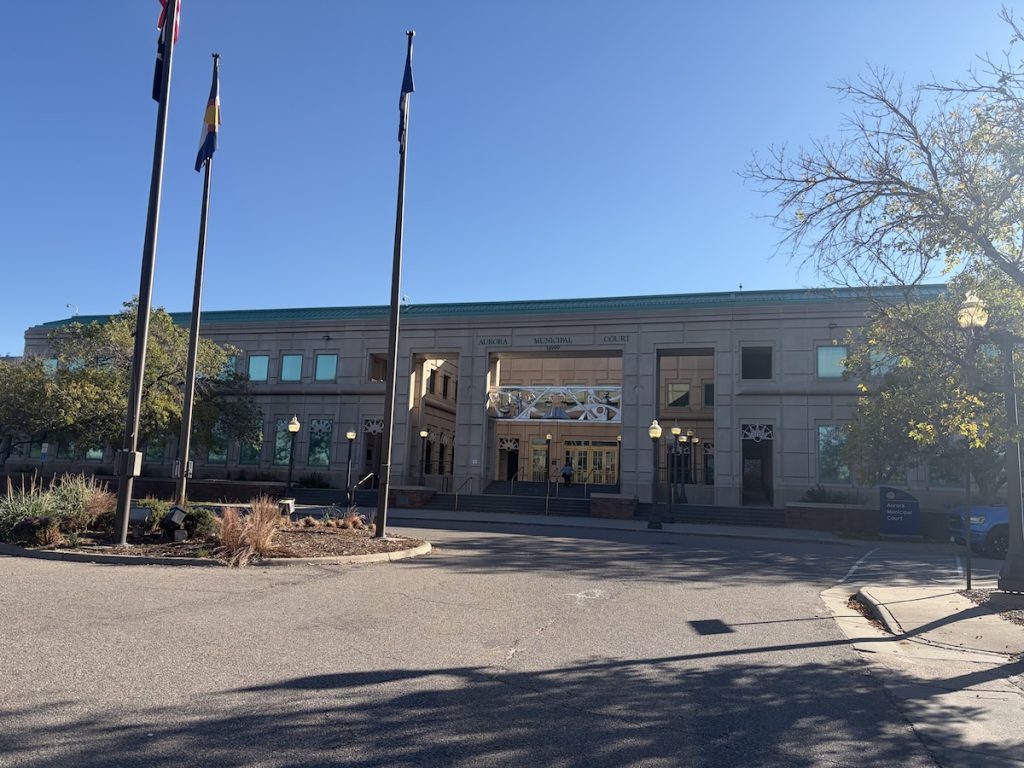
The Aurora Municipal Court is located at 14999 East Alameda Parkway, Aurora, Colorado 80012. The court has jurisdiction over violations of Aurora’s municipal ordinances, including both noncriminal traffic infractions and criminal traffic offenses.
Traffic cases prosecuted in Aurora Municipal Court generally involve violations of the city’s traffic ordinances, which incorporate provisions of the Colorado Model Traffic Code, along with certain local amendments. The court also handles other municipal ordinance violations, although traffic cases are the focus of this guide.
The Aurora City Attorney’s Office, Criminal Justice Division, is responsible for prosecuting municipal ordinance violations. Depending on the charge, a traffic case may be resolved through negotiations with the prosecutor or proceed to a hearing or trial.
Aurora Municipal Court Information
Not every traffic ticket issued in Aurora is handled by Aurora Municipal Court. Because the city extends into Adams, Arapahoe, and Douglas counties, the court responsible for a traffic case depends on the law allegedly violated and where the offense occurred.
Aurora Municipal Court handles violations of the city’s municipal ordinances. However, when an Aurora police officer issues a citation under Colorado state law, the case may be filed in one of the following courts:
Aurora Municipal Court traffic summonses generally begin with an E or Y prefix, depending on how the citation was issued. The summons should also identify the court where the case will be heard, along with the scheduled appearance date and time.
This distinction is important because municipal and county courts operate under different procedures, and the applicable charges and potential penalties may differ. Before addressing an Aurora traffic ticket, it is important to determine which court has jurisdiction over the case.
Aurora Municipal Court handles a variety of traffic violations under the city’s municipal ordinances. Aurora has adopted the 2024 Colorado Model Traffic Code, subject to certain local amendments and exceptions. Consequently, many traffic laws enforced in Aurora are similar to those enforced throughout Colorado, although some provisions differ.
Traffic violations range from relatively minor infractions to criminal offenses that can carry significant penalties. The following are some of the more common traffic charges prosecuted in Aurora Municipal Court.
Speeding is among the most frequently enforced traffic violations in Colorado. Aurora Municipal Code § 134-2(b) establishes certain local speed regulations, including a general 25 mph limit in business and residential districts, unless otherwise provided by law or posted traffic signs.
The consequences of an Aurora speeding ticket depend on several factors, including the alleged speed, the applicable speed limit, and the driver’s prior record. In addition to fines and court costs, a speeding conviction may result in DMV points that can contribute to a driver’s license suspension.
Colorado law also provides for additional DMV points for certain speeding violations under circumstances specified by statute. These additional points can make an otherwise manageable speeding ticket considerably more serious, particularly for drivers who already have points on their records.
Depending on the evidence and circumstances, it may be possible to negotiate a reduction in the charge or associated DMV points. However, the available options depend on the particular case, and a favorable resolution is never guaranteed.
Careless driving is a common traffic charge in Aurora, particularly in cases involving motor vehicle accidents. Under Colorado law, careless driving generally involves operating a motor vehicle without due regard for the width, grade, curves, corners, traffic, and other circumstances affecting the roadway.
A careless driving conviction ordinarily carries four DMV points. However, the consequences can be more serious when the alleged violation involves bodily injury or death. Depending on the circumstances, careless driving may be prosecuted as a criminal traffic offense.
Not every accident establishes careless driving. The circumstances surrounding the collision, witness statements, physical evidence, and observations of the investigating officer may all be important when evaluating the charge.
Reckless driving is a criminal traffic offense involving the operation of a motor vehicle with a wanton or willful disregard for the safety of persons or property. Unlike careless driving, reckless driving requires a more culpable mental state.
A reckless driving conviction generally carries eight DMV points and can result in fines, potential jail time, and other consequences. The seriousness of the charge makes it important to evaluate the specific driving conduct alleged, rather than relying solely on the officer’s characterization of the incident.
Depending on the evidence, circumstances, and driver’s record, a reduction to a lesser traffic offense may be possible.
Illegal street racing and speed contests have been significant traffic enforcement concerns in Aurora. Speed contest violations can involve racing another vehicle, exhibitions of speed, or other conduct prohibited by Colorado law. These offenses may carry criminal penalties, substantial DMV points, and other consequences.
Aurora has also enacted specific vehicular public nuisance ordinances addressing illegal street racing. Under Aurora Municipal Code § 134-471, prohibited activities can include street racing, burnouts, donuts, drifting, and other dangerous driving maneuvers.
In addition to criminal or traffic charges, Aurora may pursue a separate civil nuisance action involving the vehicle. Under § 134-477, a vehicle determined to constitute a public nuisance may be subject to court-ordered impoundment for 30 days to one year, along with towing, storage, and other expenses. The city may also enter into voluntary abatement agreements providing alternative remedies.
Because street racing allegations can involve criminal, licensing, and significant property-related consequences, it is important to carefully evaluate both the underlying traffic charge and any potential civil proceedings.
Aurora Municipal Code § 134-2 modifies Section 1413 of the Colorado Model Traffic Code, addressing eluding or attempting to elude a police officer.
Under Aurora’s ordinance, a driver may be charged with eluding when the driver knows or reasonably should know that a police officer operating another motor vehicle is pursuing them and willfully attempts to evade the officer. The ordinance expressly includes increasing speed, extinguishing vehicle lights, or attempting to elude the officer in another manner.
Importantly, eluding does not necessarily require a high-speed pursuit. The circumstances surrounding the officer’s attempted stop, the driver’s awareness of the pursuit, and the driver’s conduct are important considerations when evaluating the charge.
Eluding is a serious criminal traffic offense that can carry substantial penalties and driver’s license consequences.
Aurora Municipal Code § 134-8 addresses compulsory motor vehicle insurance. The ordinance prohibits operating an uninsured vehicle and certain other insurance-related violations, including failing to provide evidence of insurance when lawfully requested by a police officer.
A particularly important distinction exists between driving without insurance and failing to provide proof of insurance. Under § 134-8, a driver who establishes that valid insurance coverage existed at the time of the alleged violation may be eligible for dismissal of certain charges.
Aurora Municipal Court generally requires documentation from the insurance company verifying coverage on the date of the citation. An insurance identification card alone may not be sufficient to establish eligibility for dismissal.
Aurora Municipal Court also handles certain vehicle registration violations. In 2025, Aurora expanded municipal enforcement of registration requirements, allowing qualifying registration citations to be addressed in municipal court.
Under Aurora Municipal Code § 134-11, certain expired-registration violations may be eligible for dismissal if the registration was expired for no more than four months when the citation was issued and the vehicle is properly registered before the original first court date. A dismissal fee may also apply.
Importantly, rescheduling the court appearance does not extend the original registration deadline for purposes of this dismissal provision. Eligibility depends on the specific circumstances, and dismissal is not automatic.
Not every traffic ticket issued in Aurora is a simple traffic infraction. Certain violations, including reckless driving, eluding a police officer, and speed contest offenses, may be prosecuted as criminal traffic charges in Aurora Municipal Court.
The distinction is important because criminal traffic offenses can carry consequences beyond fines and DMV points. Aurora Municipal Court’s adult arraignment advisement identifies a general maximum penalty of $2,650 in fines and/or up to 364 days in jail. However, the penalties applicable to a particular traffic offense may be lower or otherwise limited by law. Additional court costs, surcharges, and other consequences may also apply.
Criminal traffic cases also involve different procedural considerations than noncriminal traffic infractions. Depending on the offense, a defendant may have additional rights concerning legal representation, court appearances, and trial procedures.
A criminal traffic charge should not be evaluated solely by the amount of the potential fine. The nature of the conviction, its effect on driving privileges, and any additional consequences are important considerations when determining how to approach the case.
A traffic conviction in Aurora Municipal Court can affect more than a driver’s wallet. Many traffic offenses carry points assessed against a Colorado driver’s license, and accumulating too many points within a specified period can result in a driver’s license suspension.
For Colorado drivers age 21 and older, the DMV generally applies the following point suspension thresholds:
Drivers under age 21 are subject to stricter point limits.
The number of points associated with an Aurora traffic conviction depends on the particular offense. For example, careless driving generally carries four points, reckless driving carries eight points, and speeding violations carry varying points depending on the alleged speed.
Effective August 12, 2026, Colorado law imposes additional DMV points for certain serious or repeated speeding violations. These penalties apply to convictions involving speeds of 20 mph or more over the posted limit or driving in excess of the maximum lawful speed of 75 mph.
Additional point penalties include:
These points are assessed by the Colorado DMV in addition to the points associated with the underlying traffic conviction. Consequently, drivers with prior speeding violations may face substantially greater licensing consequences than the points reflected in a negotiated plea agreement might initially suggest.
Importantly, Aurora Municipal Court does not independently determine whether a driver’s accumulated points require a license suspension. That determination is made by the Colorado DMV under applicable state law.
For drivers facing a potentially significant point assessment, the effect of a proposed plea agreement on their driving privileges can be just as important as the fine imposed by the court.
The Aurora Police Department conducts traffic enforcement throughout the city, including major highways, busy intersections, commercial corridors, and residential neighborhoods. Enforcement efforts address speeding, aggressive driving, impaired driving, and other violations that contribute to traffic accidents.
Aurora’s Traffic Section includes specialized units responsible for DUI enforcement, traffic investigations, motorcycle enforcement, and commercial vehicle safety. The department has also operated a Highway Enforcement of Aggressive Traffic (H.E.A.T.) program targeting dangerous driving behaviors along major corridors, including Interstate 225 and Interstate 70.
Street racing and dangerous driving exhibitions have also received particular attention in Aurora. Police enforcement efforts have addressed illegal racing, reckless driving, and organized gatherings involving dangerous vehicle maneuvers. As discussed above, certain street racing activities may also implicate Aurora’s vehicular public nuisance ordinances.
Aurora has additionally implemented automated speed enforcement using mobile camera systems. These systems generally involve civil traffic penalties rather than the criminal traffic charges addressed elsewhere in this guide.
Whether a citation results from a routine traffic stop, an accident investigation, or a specialized enforcement operation, the circumstances surrounding the alleged violation and the available evidence can be important considerations when evaluating the case.
The first court appearance for an Aurora traffic case is generally an arraignment. At arraignment, the defendant is advised of the charges, potential penalties, and applicable legal rights. Depending on the offense, the defendant may enter a plea of guilty, not guilty, or no contest.
If a not-guilty plea is entered, the case may be scheduled for a pretrial conference with the Aurora City Attorney’s Office. A pretrial conference provides an opportunity for the prosecution and defense to discuss the evidence, applicable law, and potential resolution of the charges without proceeding to trial.
Depending on the circumstances, a negotiated resolution may involve a reduction in the charge, fewer DMV points, or other agreed-upon terms. However, the availability of a plea agreement depends on the particular offense, the defendant’s driving history, and the prosecution’s evaluation of the case.
If the parties cannot reach an agreement, the case may proceed to trial. Criminal traffic cases may involve additional procedural rights, including the right to a jury trial when authorized by law. Aurora Municipal Court’s adult arraignment advisement specifies that a jury demand generally must be made within 21 days after entering a not-guilty plea.
The appropriate approach to an Aurora traffic case depends on the charge, the available evidence, and the potential consequences of a conviction.
Whether a defendant must personally appear in Aurora Municipal Court depends on the nature of the traffic charge, the type of hearing scheduled, and any orders issued by the court.
In certain cases, an attorney may be able to appear on a defendant’s behalf or request that the defendant’s personal appearance be waived. Depending on the circumstances and the court’s procedures, it may also be possible to request permission to appear remotely. However, these arrangements are subject to the court’s approval.
Hiring an attorney does not automatically excuse a defendant from attending court. Unless the court has expressly waived the appearance requirement or authorized an alternative arrangement, the defendant remains responsible for appearing as directed.
Failing to appear for a required court hearing can result in additional consequences, including the possibility of a warrant in criminal traffic cases.
Depending on the circumstances, it may be possible to negotiate a reduction or dismissal of a traffic charge in Aurora Municipal Court. However, the availability of a favorable resolution depends on several factors, including the nature of the offense, the driver’s prior record, the available evidence, and the prosecution’s evaluation of the case.
An important part of defending a traffic case involves reviewing the evidence supporting the charge. Depending on the circumstances, this may include police reports, body-worn camera footage, witness statements, photographs, and other available documentation. In some cases, the evidence may reveal factual disputes, legal issues, or weaknesses in the prosecution’s case.
Mitigating circumstances can also play an important role in negotiations. A driver’s history, the circumstances surrounding the alleged violation, and proactive steps taken before court may be relevant when presenting the case to the prosecutor.
A negotiated resolution may involve reducing a criminal traffic charge to a lesser offense, reducing the number of DMV points, or obtaining a dismissal of one or more charges. However, no particular outcome is guaranteed, and the available options depend on the facts and circumstances of each case.
For drivers facing criminal traffic charges, significant DMV points, or potential license suspension, evaluating the consequences of a proposed resolution is particularly important.
When a traffic case is resolved through a negotiated plea agreement in Aurora Municipal Court, the agreement may include specific conditions that must be satisfied within established deadlines. Depending on the circumstances, these requirements may include payment of fines and court costs, completion of community service, attendance at educational programs, or other court-ordered obligations.
Failing to comply with the terms of a plea agreement can have serious consequences. Depending on the agreement and the court’s orders, noncompliance may result in additional proceedings, the loss of a negotiated benefit, or other penalties.
For example, some agreements provide for a reduced charge or other favorable disposition only if certain conditions are completed as required. Failure to satisfy those conditions may jeopardize the negotiated resolution and expose the defendant to consequences associated with the original charge.
It is important to understand all conditions and deadlines before entering into a plea agreement and to maintain documentation demonstrating compliance.
Failing to appear for a scheduled hearing in Aurora Municipal Court can have serious consequences. However, the consequences depend on whether the defendant is charged with a noncriminal traffic infraction or a criminal traffic offense.
For noncriminal traffic infractions, Aurora Municipal Court advises that failure to appear as directed may result in a default judgment. This generally includes the assessment of fines, court costs, and the full DMV points associated with the original charge. An arrest warrant is not issued solely for failing to appear on a traffic infraction.
For criminal traffic offenses, failure to appear can result in the issuance of an arrest warrant. This can create additional complications beyond the underlying traffic charge and may require further court proceedings to address the warrant.
If a defendant is unable to attend a scheduled court appearance, it is important to address the situation with the court before the hearing whenever possible. Defendants should not assume that a requested continuance has been granted unless the court confirms the change.
Not every traffic ticket requires an attorney. For relatively minor violations involving few or no DMV points, some drivers may reasonably choose to handle their cases without legal representation.
However, the decision becomes more significant when a traffic charge carries substantial DMV points, potential driver’s license suspension, or criminal penalties. Charges such as reckless driving, careless driving involving injury, eluding a police officer, and speed contest violations can involve consequences that extend well beyond the payment of a fine.
An experienced traffic defense attorney can evaluate the evidence, identify potential legal and factual defenses, communicate with the prosecutor, and negotiate for a favorable resolution when appropriate. Representation may also help drivers understand the licensing consequences of a proposed plea agreement before deciding whether to accept it.
For individuals whose employment depends on driving, or who already have points on their driving records, even a seemingly routine traffic ticket can have significant consequences.
Ultimately, whether to hire an attorney depends on the seriousness of the charge, the driver’s circumstances, and the potential consequences of a conviction.
Possibly. Aurora has enacted specific ordinances addressing illegal street racing and dangerous driving maneuvers, including performing donuts in parking lots. Depending on the circumstances, the city may pursue a separate civil action alleging that the vehicle constitutes a public nuisance.
These ordinances provide for potentially significant consequences, including extended vehicle impoundment and, under certain circumstances, permanent loss of the vehicle.
Whether a vehicle can be recovered depends on the circumstances of the impoundment, the applicable legal proceedings, and the requirements for its release.
Being charged with both speeding and careless driving can carry significant consequences, including DMV points, fines, and potential driver’s license suspension.
However, receiving two charges does not necessarily mean you will be convicted of both offenses. Depending on the circumstances, it may be possible to negotiate a resolution involving a reduction or dismissal of one or both charges.
The available options depend on several factors, including the alleged speed, the officer’s observations, the circumstances surrounding the stop, the strength of the evidence, and your prior driving record.
An experienced traffic defense attorney can review the evidence, evaluate potential defenses, and negotiate with the prosecutor in an effort to minimize the consequences of the charges, including their impact on your driving privileges.
A careless driving citation following a traffic accident does not automatically mean you are guilty of the offense. The prosecution must still establish that your driving violated the applicable law.
In some cases, the investigating officer may not have personally witnessed the accident and may have relied on statements from the drivers, witnesses, physical evidence, or other information gathered at the scene.
Depending on the circumstances, it may be important to review the accident report, photographs, witness statements, available video footage, and other evidence to determine whether the charge is supported.
Whether the accident resulted in injuries is also an important consideration, as careless driving involving bodily injury can carry more serious consequences.
An experienced traffic defense attorney can evaluate the evidence, identify potential defenses, and explore whether the charge can be reduced or dismissed. The appropriate strategy depends on the circumstances of the accident, the available evidence, and the driver’s prior record.
Depending on the issuing agency and the statute or ordinance cited, a traffic ticket issued on I-225 may be handled in county court rather than Aurora Municipal Court.
Yes. Street racing charges can carry significant criminal and driver’s license consequences. When police also seize a vehicle, the situation becomes more complicated.
Aurora has enacted specific ordinances addressing illegal street racing and vehicles allegedly used in dangerous driving activities. Depending on the circumstances, the city may pursue a separate civil action seeking to have the vehicle declared a public nuisance.
These proceedings can result in extended vehicle impoundment and, under certain circumstances, permanent loss of the vehicle. Importantly, the criminal traffic charge and the civil proceedings involving the vehicle may present separate legal issues.
An experienced traffic defense attorney can evaluate the evidence supporting the racing charge, examine the circumstances surrounding the vehicle seizure, and determine what options may be available to challenge the charge and seek the vehicle’s return.
Prompt legal attention is particularly important when a vehicle has been seized, as separate procedures and deadlines may apply.
In certain circumstances, an attorney may be able to appear on a defendant’s behalf or request that the defendant’s personal appearance be waived. However, whether an appearance can be excused depends on the charge, the hearing, and the court’s approval. Defendants should not assume they are excused unless the court has authorized the arrangement.
If you have been charged with a traffic offense in Aurora Municipal Court, understanding your legal options before resolving the case is important.
With more than 20 years of experience representing individuals charged with traffic offenses throughout the Denver metropolitan area, I provide legal representation in cases involving speeding, careless driving, reckless driving, speed contests, driving without insurance, and other traffic violations.
Every case presents different circumstances. My approach involves reviewing the available evidence, evaluating potential defenses, and working toward a favorable resolution while considering the potential consequences for your driving record and driver’s license.
If you have received a traffic summons requiring an appearance in Aurora Municipal Court, please contact my office to discuss your case and available options.
The map below shows the location of Aurora Municipal Court at 14999 East Alameda Parkway in Aurora, Colorado.


